Deco planner comparison
Abysner vs Dive Kit
Two honest Bühlmann planners, built around different priorities
Both run the Bühlmann ZH-L16 model with gradient factors, fully offline on iOS and Android, and both plan open circuit and CCR. Abysner is open-source and a few dollars on the app stores (free if you build it yourself), with an engine you can read. Dive Kit is a pricier deco planner wrapped in a free toolkit, with more sophisticated CCR and contingency tooling, plan sharing, and eight languages. Neither is a cut-down version of the other.


Common ground
The same engine family where it counts
Both planners are built on the same published decompression model.
Bühlmann ZH-L16 with gradient factors
Sixteen tissue compartments, with nitrogen and helium tracked separately so trimix is handled correctly. Abysner lets you pick the A, B, or C coefficient set; Dive Kit uses C.
Open and closed circuit, offline
Both plan open-circuit and CCR dives entirely on-device, with no network connection needed, on iOS and Android.
Oxygen, environment, repetitive dives
Both accumulate CNS and OTU, account for altitude and water salinity, and carry tissue state across a surface interval for repetitive dives.
Two correct ZH-L16C implementations can still produce slightly different schedules, because the model leaves last-stop handling, stop rounding, and gas-switch timing to the implementer. That is why both projects encourage cross-checking. Abysner lets you read its Kotlin engine. Dive Kit's engine is closed, so it takes the other route and publishes a reproducible cross-reference against MultiDeco across 33 scenarios.
How they feel to use
Where the two planners overlap, and where each one goes further.
One screen, no clutter
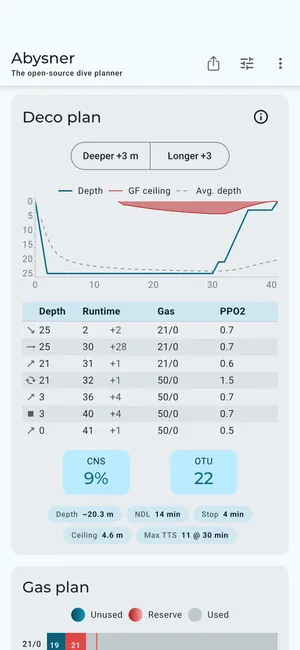
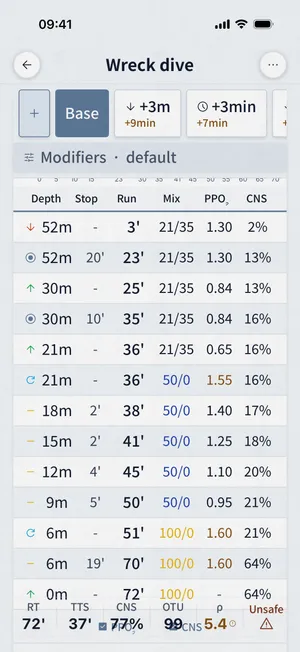
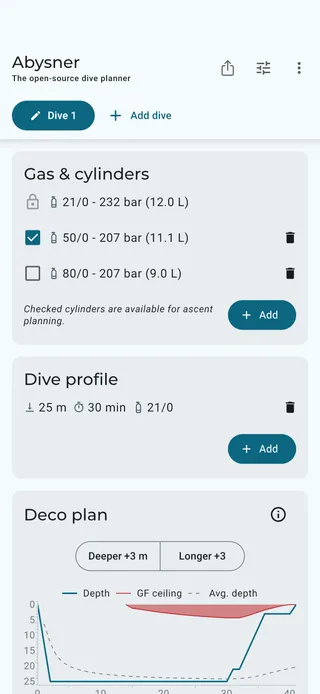
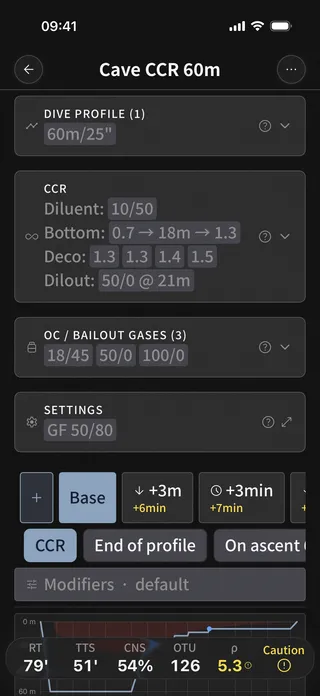
Abysner puts cylinders, the dive profile, and the deco plan on a single scrolling screen, and it is genuinely pleasant to move around. Dive Kit splits the same inputs into labelled cards with live END, gas density, and ppO₂ feedback as you type.
Abysner
Dive Kit
Choosing a gas
Both make gas selection quick and show MOD and density at a glance. Both cap ppO₂, differently: Abysner uses two global limits (1.4 working, 1.6 deco), while Dive Kit caps per gas and bands deco-gas switching by the gas's O₂ content (lean 1.4 / mid 1.5 / rich 1.6), so the same cap drives the switch depth and the hyperoxia warning.
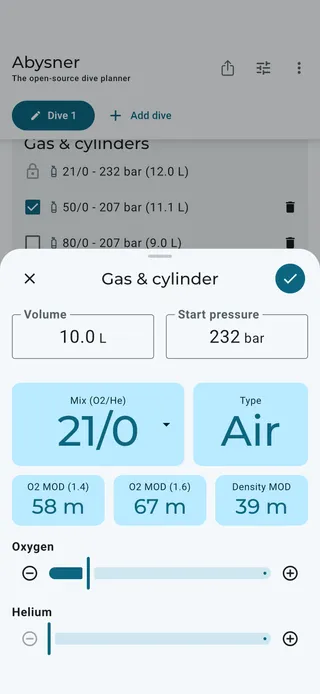
Abysner
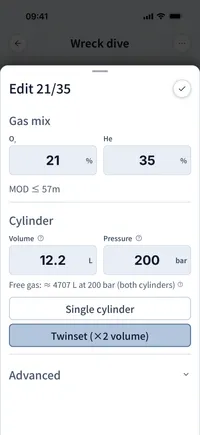
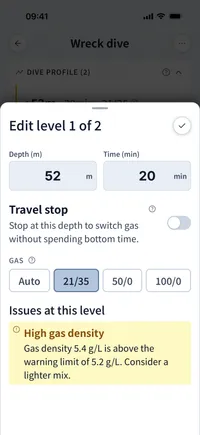
Dive Kit
The deco plan
Both produce a clean stop table with a depth-and-ceiling profile, CNS and OTU, and deeper-or-longer contingency views. Dive Kit can show stop times rounded to whole minutes, to 30 seconds, or exact.
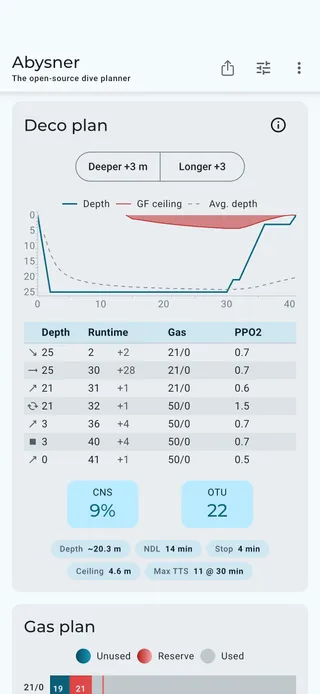
Abysner
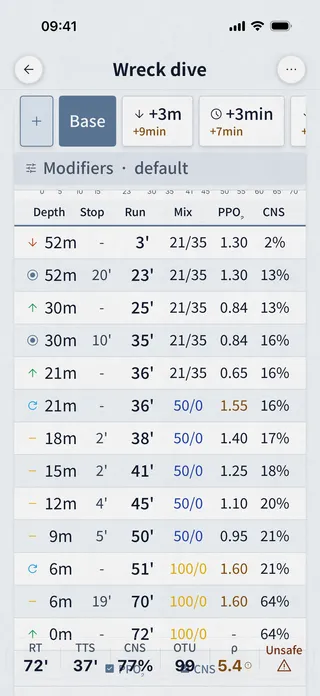
Dive Kit
Gas planning
Both work cylinder pressures from real-gas behaviour rather than the ideal gas law, Dive Kit's model is built from NIST reference data for O₂, N₂, and He. Abysner shows used, reserve, and remaining per cylinder with density and ppO₂ limits; Dive Kit shows per-cylinder consumption bars across the whole dive, contingencies included.
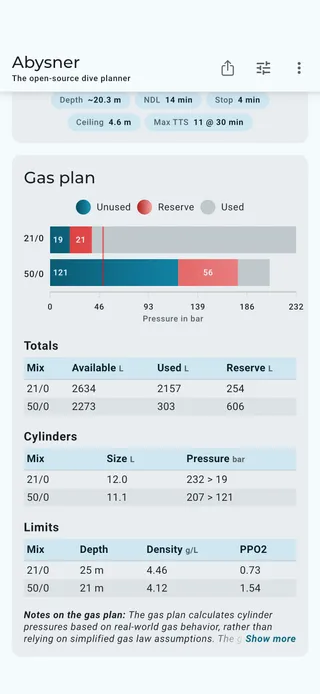
Abysner
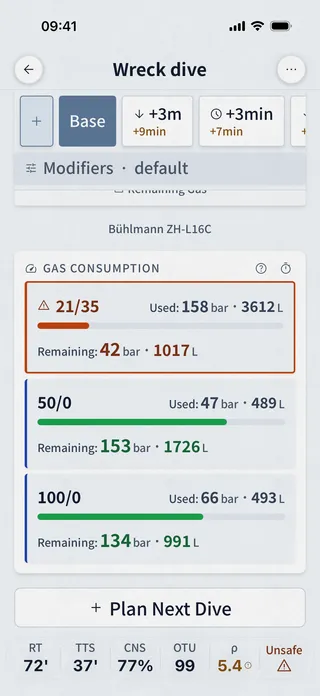
Dive Kit
Sharing a plan
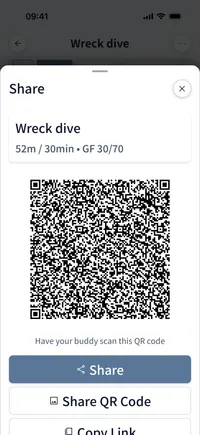
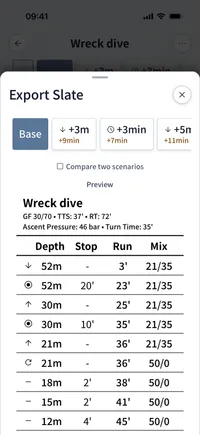
Abysner renders a clean plan image you can save and send. Dive Kit also shares a plan as a QR code or URL that opens straight into a buddy's app with every scenario and warning intact, or in a browser-based web viewer if they do not have the app. Its slate export is a high-contrast black-and-white slate at A6 size, output as an image or a PDF, so it scales cleanly onto a real wrist slate or a printed card.
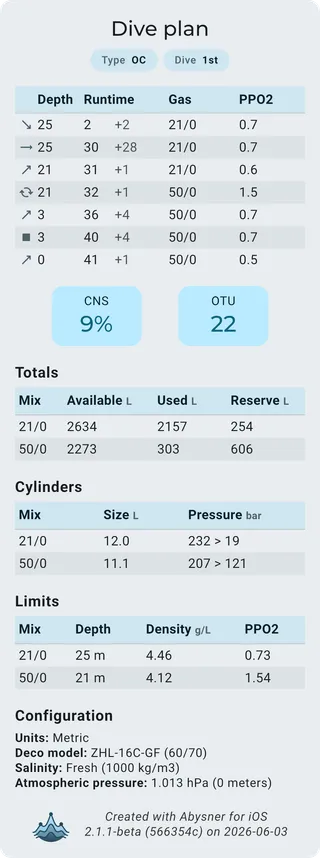
Abysner
Dive Kit
A planner, or a whole kit
Abysner keeps the tools a plan needs inside the planner and stays focused, which is a fair design choice. Dive Kit surrounds the planner with a dozen free standalone tools, Gas Blender (partial-pressure and continuous/rotameter), Best Mix, a Gas Analyzer for EAD/END/ppO₂, Gas Usage, RMV/SAC, a neoprene-aware Buoyancy & weighting calculator, Unit Converter, and a cylinder database, plus a dive log, gear and weighting tracking, and certification cards. It is a dive companion, not just a planner.
Dive Kit only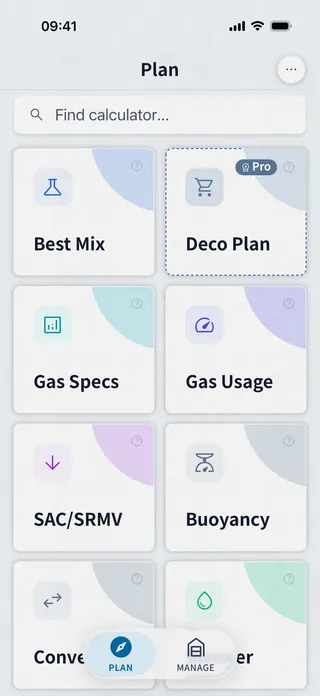
Feature by feature
Where Abysner and Dive Kit are the same, and where they part ways.
| Feature | Dive Kit | Abysner | Notes |
|---|---|---|---|
| Algorithm | ZH-L16C | ZH-L16 A/B/C | Both are Bühlmann with gradient factors. Abysner lets you choose the coefficient set. |
| Gradient factors | Yes | Yes | GF Low and GF High, interpolated with depth, in both. |
| Open circuit | Yes | Yes | Multi-gas with MOD-based switching in both. |
| CCR | Yes | Yes | Both plan CCR with descent and bottom setpoints, an auto-switch depth, loop volume and metabolic O₂. Dive Kit goes further: a depth-keyed deco-setpoint schedule, dilout switches, air breaks, and an OC bailout view with an isobaric counter-diffusion check. |
| Trimix / helium | Yes | Yes | Nitrogen and helium tracked separately in both. |
| ppO₂ model | Per-gas, O₂-banded | Working / deco caps | Abysner uses two global limits, max ppO₂ 1.4 in the working phase, 1.6 in deco. Dive Kit caps ppO₂ per gas and bands deco-gas switching by O₂ content (lean 1.4 / mid 1.5 / rich 1.6). |
| Stop-time precision | Whole · 30s · exact | Whole minute | Dive Kit can show whole-minute, 30-second, or exact stop times; Abysner rounds to whole minutes. |
| Contingency planning | Yes | Partial | Dive Kit has presets plus a custom builder (lost gas, depth/time deltas); Abysner generates a deeper-and-longer plan. |
| Plan variants | Yes | Partial | Dive Kit saves named variants with graph overlay; Abysner offers deeper / longer views. |
| Safety warnings | Yes | Partial | Dive Kit has a severity-sorted warning sheet recomputed per scenario; Abysner surfaces CNS, OTU, ppO₂, and density warnings. |
| Altitude & salinity | Yes | Yes | Both fold altitude and water type into ambient pressure and the ceiling. |
| Repetitive dives | Yes | Yes | Tissue carry-over across a surface interval in both. |
| CNS / OTU | Yes | Yes | Both accumulate oxygen exposure. |
| Plan sharing | QR · URL · web · slate | Plan image | Both export a plan image; Dive Kit adds QR and URL deep links and a web viewer. |
| Companion tools | 11+ | In-planner | Dive Kit ships standalone calculators, logging, gear, and certs; Abysner keeps supporting tools inside the planner. |
| Languages | 8 languages | English | |
| Open source | No | Yes | Abysner is AGPL-3.0, so its deco engine is fully auditable. Dive Kit's engine is closed-source. |
| Stated validation | vs MultiDeco (published) | Open source + author checks | Dive Kit publishes a 33-scenario cross-reference against MultiDeco; Abysner's validation is its readable source and the author's own cross-checks. |
| Price | $24.99 lifetime | $2.99 | Abysner is $2.99 on the App Store (or free to build from source). Dive Kit's deco planner is $24.99 lifetime; its companion tools are free. |
| Platforms | iOS · Android | iOS · Android | iOS and Android in both. |
| Works offline | Yes | Yes | Both calculate entirely on-device. |
| Maturity | Shipping | Beta (2.1.1) | Abysner labels itself beta and recommends cross-checking its output. |
| Units | Metric · Imperial | Metric · Imperial | Both support metric and imperial (Abysner added imperial in 2.1.0). |
Only Dive Kit does this
- Full CCR loop: a depth-keyed deco-setpoint schedule, dilout switches, and air breaks
- A custom contingency builder (lost gas plus depth/time deltas)
- Plan sharing by QR, URL deep-link, web viewer, and an A6 printable slate (image or PDF)
- Sub-minute stop-time precision (whole-minute, 30-second, or exact)
- An O₂-banded deco ppO₂ model (lean 1.4 / mid 1.5 / rich 1.6)
- A free toolkit: Gas Blender (partial-pressure + continuous), Best Mix, Buoyancy & weighting, Gas Analyzer, SAC/RMV, and more
- A dive log, gear & weighting tracking, and certification cards
- In-app tutorials and a public guide site for divers still learning
- Eight languages (English, German, Polish, Russian, Swedish, Turkish, Simplified Chinese, Korean)
Frequently asked questions
Abysner vs Dive Kit, answered honestly.
Is Abysner free?
Do Abysner and Dive Kit use the same decompression algorithm?
Is Abysner open-source, and can I read its deco engine?
Does Abysner support imperial units?
Does Abysner support CCR or rebreather diving?
Which is better for technical or CCR diving?
Is Abysner production-ready?
What languages does each app support?
How can I check Dive Kit if the engine is closed-source?
Can I cross-check plans between Abysner and Dive Kit?
Sources
Abysner details were verified from its open-source repository (AGPL-3.0, github.com/NeoTech-Software/Abysner) and its store listings, version 2.1.1, on 2026-06-03. We have not run a numeric schedule comparison between the two engines, so this page compares implementation and features, not measured deco tables.
Get Dive Kit
Eleven tools free. Deco Planner: free trial, then $4.99/month or $24.99 lifetime.